This site uses cookies to provide you a better user experience and analyze site traffic.
By using this site, you consent to cookies. For more information, please read our privacy policy.
Do you want to learn more about writing, including receiving marketing tips and tricks, deals on valuable workshops and retreats, and time management hacks? Join the VIP Writer’s Club!
Hey, guys! Spring is here and I've got things to say, news to share, life pinatas to crack open. As such, I'm excited to start blogging regularly(ish). As a good faith effort, below is the first Writing Whip-it, something I envision being a regular deal (in the same way I envision fitting back into my 1994 Girbaud jeans because nothing good happens if you don't vis-U-alize it, people) where I offer a brief writing tip (500 or fewer words).
Reading Like a Writer
Imagine being a chef who only eats chicken nuggets, a carpenter who refuses to look at buildings straight on, or an orchestra conductor who doesn't listen to anything but commercial jingles. Such is the problem for a writer who doesn't read regularly and widely.
Books are the maps to your craft.
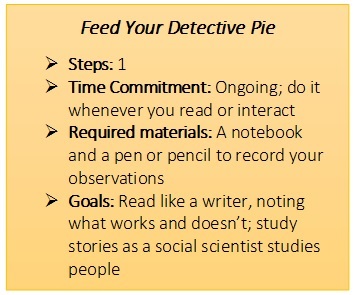
Reading like a writer requires you to figure out what in a piece of fiction moves you and what turns you off. I'm calling that self-awareness your narrative detective—its job is to solve the mystery of the narrative, looking at the ways it is and isn't succeeding—and I'm going to encourage you to feed it PIE every time you read anything: a menu, a short story, the interpretive plaque next to the world's biggest redwood tree.
A book.
Here's the ingredients to the PIE:
P: prepare with pen and paper. In other words, always have a notebook and something to write with nearby when you read. Be prepared for insight. A writer cannot simply read for pleasure. S/he uses every word as research.
I: immerse. Get inside the words, the sentences, the story arc. Don't simply stay on the surface of what you're reading, no matter how shallow it seems. Go deep.
E: examine. If that cereal box makes you excited to eat the Sugar Doodles, ask yourself what it is about the words and their formatting is doing that for you. If you read that redwood plaque and walk away feeling smart, ask yourself how it pierced your busy mind. If—especially if—you're reading a book, and you connect with a character, or you find yourself yanked out of the story, or you read a sentence twice to savor the citrus taste of it, study that shit like a lover's face. Write down what you think is happening ("main character makes stupid choices," "too many adverbs," "lots of smell detail drops me straight into the story," "each chapter ends with a hook," etc.) because transcribing information flips a switch in our brain, waking up the records guy who then goes over to pick up what you wrote and file it somewhere so you can access it later.
When you feed your narrative detective PIE, she begins to internalize the language and rhythm of story. The results, like magic, will begin to show up in your own writing.
Jessica (Jess) Lourey is best known for her critically-acclaimed Murder-by-Month mysteries, which have earned multiple starred reviews from Library Journal and Booklist, the latter calling her writing "a splendid mix of humor and suspense." She is a tenured professor of creative writing and sociology, a recipient of The Loft's 2014 Excellence in Teaching fellowship, and leads better-than-average writing workshops all over the world. Salem’s Cipher, the first novel in her thrilling Witch Hunt Series, hits stores September 2016. If you'd like to see a specific topic addressed in a future Writing Whip-it, please email her at jesslourey@yahoo.com, with "Writing Whip-it Request" as your subject line.
Tell all the Truth but tell it slant —
Success in Circuit lies
Too bright for our infirm Delight
The Truth's superb surprise
As Lightning to the Children eased
With explanation kind
The Truth must dazzle gradually
Or every man be blind —
—Emily
On September 13, 2001, I stood in front of my multicultural lit class assigning a response essay. The class was small, five students, all of them enrolled in my Technical Communication program. Because I taught all but one of their courses, we’d become a sort of tribe. I remember being excited about the assignment. I don’t remember what I was wearing. I do remember I was growing my hair out, and that I was worried about the pregnancy weight I was putting on and whether or not something I’d elected to call “Second Lunch” was doing me any favors. I remember being tired. It was a Thursday.
The door opened, and the college’s office administrator stepped into the room. It was a first. She was unable to meet my eyes.
“Can you please come to the Dean’s office?”
“Yup.” I grabbed my briefcase. I knew I wasn’t coming back.
###
Sure, I devoured Trixie Belden and Nancy Drew growing up, but read mysteries as an adult? No thanks. I’d earned a Master’s degree in English, and if that doesn’t cure you of love for genre fiction, nothing will. I’d read most of the classics, explored the margins, analyzed poetry until there was nothing left on the page but brittle black shapes. I’d gone through a Tom Robbins stage, an Anne Rice phase, a Carlos Castaneda period, but no mysteries. As an adult, I only read real books.
###
Our final conversation 36 hours earlier had ended exactly like this:
HIM: You’re beautiful.
ME: Silence.
HIM: I love you.
ME: I don’t think that means the same thing to you as it does to me.
We’d been married for 24 days. I was three months pregnant. We’d timed it so that I could have the summer off after the baby was born, not expecting that we’d nail it on our first try. It was 9/11. The University of Minnesota conference I’d been driving to that morning had been unexpectedly canceled as college campuses all over the country shut down. We were under attack.
I returned home to find something I hadn’t expected to find.
###
There were two plainclothes detectives sitting in the Dean’s office. They rose when we entered. The office administrator disappeared. I was with strangers.
“Is my daughter all right?” The question was a peculiar politeness in that overexposed moment, an invitation for the detectives to deliver good news before they leveled my world. My baby girl was three, and it was naptime in the daycare across the street. I knew she was fine because I would have known if she wasn’t. I also knew that my husband had killed himself.
I had known I would be here, or somewhere like here, since the fist of blackbirds had flown at my car as I’d returned from the canceled U of M conference on 9/11. It was their warning that had forced me online to search his history, the coldness of their black bodies blocking out the sun that had warned me my life was never going to be the same again.
But I couldn’t have known.
He was not depressed. He was a successful DNR ecologist with a family who loved him. He made pies for the hospice care bake sale and volunteer coached the local youth soccer league. We were newlyweds with a baby on the way. And so I took the chair the detectives offered, and I watched their faces, and I felt every part of me shut down except my eyes and my ears. These organs became disconnected recording devices, and so while I can recall the entire conversation, it doesn’t mean any more now than it did then. Just words.
“Do you know where your husband is?”
“Um, we had a fight two days ago. He went to his old house, the one we have on the market? I haven’t heard from him.”
They exchanged glances. Their suits were nice. Both men looked like what I imagine New York detectives look like, polished as stones. The detective who drew the short straw adjusted his collar. “Your husband has killed himself.”
I felt the baby kick, or did I just feel kicked? “When?”
“He was found today, by a coworker. There was a murder-suicide in the same DNR office two years ago, and they were worried for you and your daughter.”
“He killed himself today?”
“He was found today.”
This is important. If he killed himself immediately after our fight, that meant I’d been thinking about a dead man, emailing a corpse, for two days. But I already knew the truth of that, too.
His ghost had visited me the first night.
###
Mysteries involve murder. They can also include sex, humor, and intrigue, but if it’s a grown-up mystery, people are going to expect a body, preferably in Chapter 1. I knew this. Everybody knows this. Mysteries are also formulaic, another widely accepted belief.
What I didn’t know until my husband’s suicide was that mysteries are also, at their simplest, about understanding human nature and finding closure. I found myself suddenly, urgently, needing both. A friend had lent me a Sue Grafton alphabet mystery a couple years earlier. I read it, and then I went to the library and checked out more. When I read all of these, I turned to Tony Hillerman. Then Janet Evanovich. William Kent Krueger. I was greedy, always a fast reader, stuffing one into my head, then another, and another.
Each one pulled dark secrets into the light.
Each one ended with The Answers.
###
The United States is a pop psychology culture. We know the five stages of grief, and that alcoholism is a disease, that communication is key, that men are from Mars and women from Venus. Here are things, however, that they don’t tell you about suicide:
1. If you hear the last words of your husband, and they come after he has made up his mind to end his life, you will forever be able to replay them in your head in Dolby surround sound. This is because there is an audible click that happens when a living man begins to speak like a dead man, and a dead man’s voice is terrifying.
2. The police officer at the station will mean well, but he still has to ask you if you want to take home the gun your husband shot himself with. If the officer is also new to the force, he may wonder aloud, with a mixture of awe and revulsion, how a person could choose a muzzle-loading rifle to do the deed. Finally, if he is both new to the force and young, he may hand you your husband’s glasses without noticing that they have tiny fragments of gray and red matter on them.
3. The phlebotomist taking your blood may not consider what brought you into her lab, or guess that after six agonizing weeks, you’ve finally decided to remove your wedding ring. She will only see a pregnant, single woman getting an HIV test, and you will disgust her.
4. Trying to get a handle on grief without answers is like trying to take a picture of the whole world while standing on it.
###
I’d read thirty mysteries in a matter of weeks before I finally decided to write one. It was January of 2002. My belly was swollen. I could go an hour at a time without thinking of him. My brain and heart were starved. I lived at the end of a lonely country road that the plows visited last, and I saw how people were looking at me. Eight months pregnant. Husband killed himself. Out there alone with a three-year-old, 40 miles from the nearest hospital.
People wanted to help. They worried about me. I still carry that with me, all the worry they had, all the pain they tried to haul for me so I wouldn’t have to heft it alone. Not just my friends and family, but strangers reached out to hold me up, and they didn’t stop even after the funeral. Grief is very selfish, though, and so I could only watch and keep turning inward.
Writing a novel saved me.
###
Here’s how *May Day*, the first mystery I wrote, begins:
* I tried not to dwell on the fact that the only decent man in town had stood me up. Actually, he may have been the only literate, single man in a seventy-mile radius who was attracted to me and attractive. The warm buzz that was still between my legs tried to convince the dull murmur in my head that it was just a misunderstanding. To distract myself from thoughts of Jeff’s laugh, mouth, and hands, I downed a couple aspirin for my potato chip hangover and began the one job I truly enjoyed at the library: putting away the books.
I glanced at the spines of the hardcovers in my hands and strolled over to the Pl-Sca aisle, thinking the only thing I really didn’t like about the job was picking magazine inserts off the floor. Certainly the reader saw them fall, but without fail, gravity was too intense to allow retrieval except by a trained library staff member. I bet I found three a day. But as I teetered down the carpeted aisle in my flowered heels, I discovered a new thing not to like: there was a guy lying on the tight-weave Berber with his legs lockstep straight, his arms crossed over his chest, and a reference book opened on his face. He was wearing a familiar blue-checked shirt, and if he was who I thought he was, I knew him intimately. A sour citrus taste rose at the back of my throat. Alone, the library aisle wasn’t strange; alone, the man wasn’t strange. Together, they made my heart slam through my knees. I prodded his crossed legs with my foot and felt no warmth and no give.
My eyes scoured the library in a calm panic, and I was aware of my neck creaking on its hinges. I could smell only books and stillness, tinged with a faintly coppery odor. Everything was in order except the dead man laid out neatly on the carpeting, wearing the same flannel I had seen him in two days earlier. I wondered chaotically if dead people could lie, if they still got to use verbs after they were gone, and if maybe this was the best excuse ever for missing a date. Then I had a full-body ice wash, five years all over again, a nightmare pinning me to my bed as I silently mouthed the word “mom.”
Had proximity to me killed him?*
###
On February 28, 2002, six months and two weeks after Jay’s suicide, I called my mom and asked if she’d stay overnight at my house. She had driven the two hours one way to sleep over every Monday since his death, but this was a Thursday. My dad visited when I asked, was over regularly to repaint walls and fix leaks, but he preferred his own bed and had never slept in my house for any reason. He asked if he could come with mom on the 28th, though. I said sure, I needed him to help carry some wood for the woodstove.
My water broke that night, with my parents sleeping upstairs in the spare bedroom and my daughter tucked safely in her room. I wasn’t yet having contractions, but I rang the hospital to let them know that I’d be arriving soon. I’d called the hospital at least three times before to make advance arrangements for my daughter’s birth and then my son’s. Each time, different people, always female, answered the phone the same impersonal way: “Douglas County Hospital, how may I direct your call?”
This time, the nurse on the other end of the line was a man. “This is Jay. How can I help you?”
Jay. My husband’s name. I held the phone.
“Hello? Is someone there?”
“I’m having a baby.”
“Fantastic!” He sounded so excited that I surprised myself by smiling. “Has your water broken?”
“Just now.”
“First baby?”
“Second.”
“Why don’t you come in now. We’ll take care of you.”
My dad stayed with my daughter so she could sleep through the night. My mom drove me in. Jay took care of everything, just as he’d promised. My son was born healthy, and looking exactly like his dad. I had planned a big-sister party at the hospital, so Zoё, my little girl, arrived to balloons, presents, and cake, all for her. She gathered the bounty around her and declared that having a little brother wasn’t half bad.
###
I’ve never written factually about my husband’s suicide before the words that you’re reading right now, but if you know my story, you can find it in every novel I write. My anxieties work themselves out in each book. I still hear his voice, I still fear the betrayal and loss that are around every corner, but I get to write the story, and at the end, the mystery is always solved. This is a slant way to deal with loss, but it’s the only way I can do it. Only fiction offers me the truth.
What I have come to call fiction therapy didn’t provide a clear, linear path from trauma to healing and redemption, of course. I was no pretty flower busting out of the crack in the pavement against all odds. The process was and continues to be a messy, three-steps-forward, two-and-a-half-steps-back kind of deal. This important reality is encapsulated in what I refer to as Pee Day. It happened three months after Jay shot himself.
Minnesota was clutched in the cold, dead heart of winter. December, some people call that. I was heading to the basement to do laundry. I stepped off the bottom step into a puddle of dog pee, slipped, and landed on my back without any mediating flailing, just smack, pregnant lady flat on the linoleum-covered cement, soaking up cold urine like a filthy human sponge, staring at the ceiling. Maybe my head hit first because I couldn’t decide what to do next, didn’t even have the wherewithal to worry. In fact, I remember being profoundly relaxed, like I'd finally found my place in the world.
Out of the corner of my eye, I saw Zoё skipping out of her playroom. Using a beautiful logic unique to three-year-olds (*mommy is playing lay down!*), she was delighted rather than alarmed to find me sprawled out. She sat cross-legged at my head and wiggled her body underneath me. Now the dog pee was dripping from my hair onto her lap.
“We’ll be okay, mommy,” she said. I’m not sure to this day what she meant by that. Probably she was only repeating what I said to her daily as a sort of prophylactic wish. In any case, it was exactly the right thing to say. She began to pet my head like I did for her when she was sick. As she stroked my pee hair, she hummed a song, equal parts “Happy Birthday” and “Frere Jacques.” The dog padded downstairs and curled next to me. The three of us stayed like that until I remembered how to move.
If there were to be a poster emblematic of my first year of recovery, it’d be that image of faith, love, and pain coexisting in a puddle of dog pee.
*We’ll be okay, mommy.*
Thanks to the love and support of family and friends and the gentle guidance of fiction therapy, we were. We will be. And I believe everyone deserves that, and so I'm writing Better than Gin, which contains hard-won directions on how to alchemize pain into gold.
I do have a request, though. As you read Better than Gin, please don’t think of entering the fiction therapy process as trying out for the Trauma Olympics. You don’t win the gold the more pain you’ve experienced, though I think we all sometimes secretly believe that. Pain is pain. Bad is bad, good is better. For the love of Betsy, sometimes I’m sad or angry for no discernible reason. It counts.
If you still feel like you need a pass to enter the writing club, I offer you this: transgenerational epigenetics is strongly suggesting that a sense of trauma can be passed down to you from your ancestors. That means if great-grandma Esther had a rough time of it, you can feel emotionally sapped even if your life is pretty good. Fiction therapy helps you where you’re at. The novel you will write functions as both your lighthouse and the Viking funeral boat upon which you get to burn your baggage once and for all. This process is about evolving to be the best version of yourself that you can be, and we all benefit from that.
Along those same lines, you don’t need to be a gifted writer for fiction therapy to work. If you have something to write with or on, you are golden. I guarantee you’re going to surprise yourself with what you create, on paper, inside yourself, and in the world.
So come on. Pack what you need. We’re in this together.
###
*Deep sigh.*
Are you still with me?
That's the intro chapter to *Better than Gin: Transform Your Facts into Fiction that Sells (The One Year, One Book Challenge)*. Thank you for reading it. I'm finally writing this book because I found something that resembles courage (but looks more like accidentally dried fruit that you found under the couch--this stuff isn't pretty) and because it's too important to keep to myself. If writing a novel is as healing, empowering, and freeing as I say it is--and it is--who am I to keep the instructions on transforming life experiences into fiction to myself, as much as the German in me is violently opposed to revisiting and revealing the darkest chapters of my life?
If all goes according to plan (ha!), I'll have the book written, edited, and to my agent to try and sell by March 1 of next year. I'm also putting together a full-day writing workshop based on the book (see table of contents below), its goal to teach others how to transform the crunchy bits of their life into a healing, compelling novel, so please spread the word if you know any writer's workshops or conferences that might be interested.
Aaaannnnd...that's enough vulnerability for one day, maybe a few months. Plan on me retreating to the comfort of cat videos and bathroom humor exclusively until Christmas at the earliest.
Big love to you!
Better than Gin
Working Table of Contents
Introduction
The Power of Fictionalizing Your Life
I. Why You Should Turn Your Facts into Fiction
II. Reading Like a Writer to Write Like a Writer
III. The Art of the Chickenshitography: Centering Yourself in Truth before Writing Fiction
Writing and Publishing the Novel
IV. A Quick and Dirty Dip into Novel Genre, Structure, and Format
V. Sifting through Your Past to Select Your Strongest Concept
VI. Talk to the World in the Dark: Crafting Your Characters
VII. Mining Memories to Create a Cinematic Setting
VIII. Fire Up the Pyramid on Point (POP) Machine and Write Your Book
IX. Getting All Your Dicks in a Row: the Importance of Editing and Revision
X. I’ve Got an Attic Full of Art. So Now What?
Empowering and Transforming Yourself
XI. Bring Me Beer, Courage, and a Kitten: a Day in the Life
XII. Joining the Tribe
XIII. Making Magic
One year ago today, I refinanced my house so I could afford to take a year off to write novels. The goal was to land The Contract that would allow me to write full-time. That didn't happen, and as a result, I'm returning to teaching in three weeks. It's not the hoped-for outcome, but it's a good lesson in humility, patience, and whatever other karmic cod liver oil the universe has on tap for me. I'm honestly a little excited because if there's one thing I know for sure, it's that the best gifts come wrapped in the shittiest paper. I mean literally, paper that has been rolled in shit, taped together with humiliation, and decorated with tapeworm ribbons and fear glitter. So yay!
I've been thinking a lot about the one-year reset because of the anniversary but also because two friends of mine, both of them gifted writers, have undertaken a similar endeavor. Like me, they were both over-scheduled hyperachievers. Also like me, they're both struggling with the first couple months of their new lives. I don't think one has to leave his/her job to experience this reset. You can find it in the backdraft left by the absence of anything important--the ending of a relationship, the loss of a loved one, a major move. It doesn't have to last a year, either, though in my experience, it takes at least six months for what you've been running from to catch up with you. It's really hard to stand still for that.
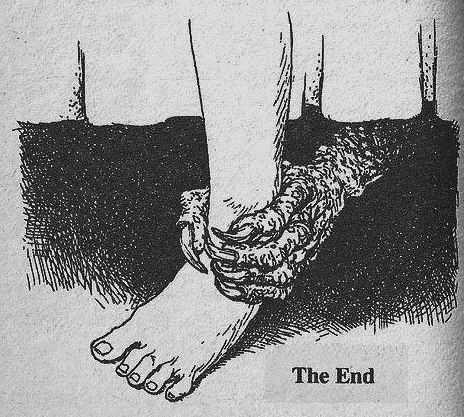
That's why many people rush to fill that time with something or someone. I spent the first three months of my writing year lost in social media, aimlessness, and the crises of family and friends. Eventually, the sense that I was wasting something precious won over the ennui, and I stood still long enough to set my metaphorical feet on the floor and let the monster reach out from under the bed and grab my ankles.
You know what happened? I realized I was the monster. Ha! Super Grover was right.
So, I wasted a few months, and then I edited, Kickstarted, and self-published the book of my heart, wrote another good book, read several, listened to my kids rather than rushed them from one location to another, traveled, dusted off the courage to tackle two books that I should have written a decade ago, realized that I am built to be a writer, and washed my heart clean. I loved that time, but what I love even more was that I gave myself such a wonderful present. I'm also thrilled for what this year has in store for my friends. They have no idea how amazing it's (they're) going to be.
Interested in free books, exclusive bonus content, and VIP early access to Jess’ upcoming projects? Then sign up here to become a VIP Reader. You’ll immediately receive a free copy of May Day, the first in the Mira James comic caper mysteries, just for signing up!
Do you want to learn more about writing, including receiving marketing tips and tricks, deals on valuable workshops and retreats, and time management hacks? Join the VIP Writer’s Club! You’ll receive free VIP access to an online novel-writing course just for signing up and can unsubscribe from the newsletter at any time.
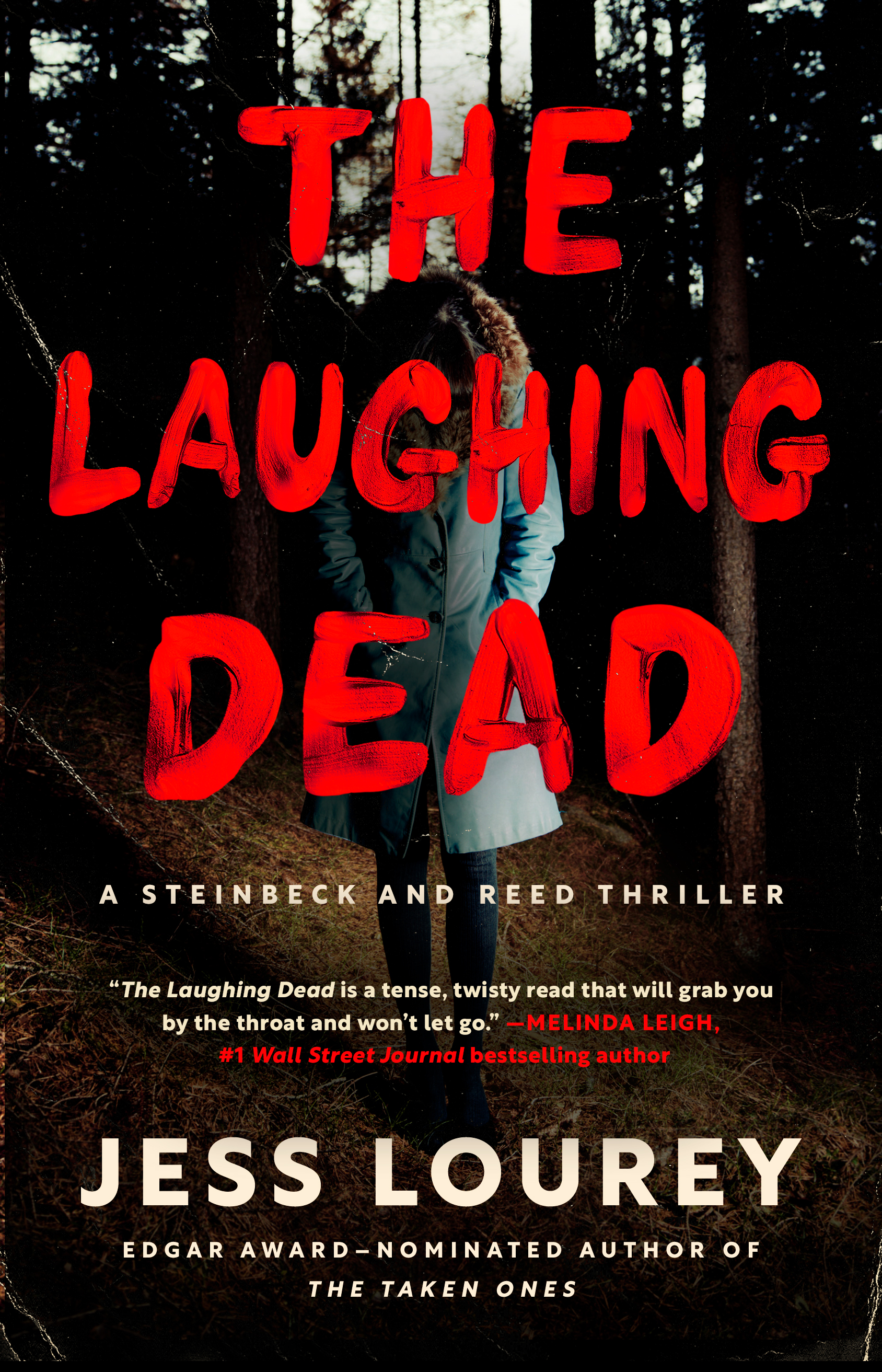
Two murder investigations, decades apart, threaten to expose a cold case agent Van Reed’s darkest secrets in this pulse-pounding third book in the Edgar Award–nominated series.